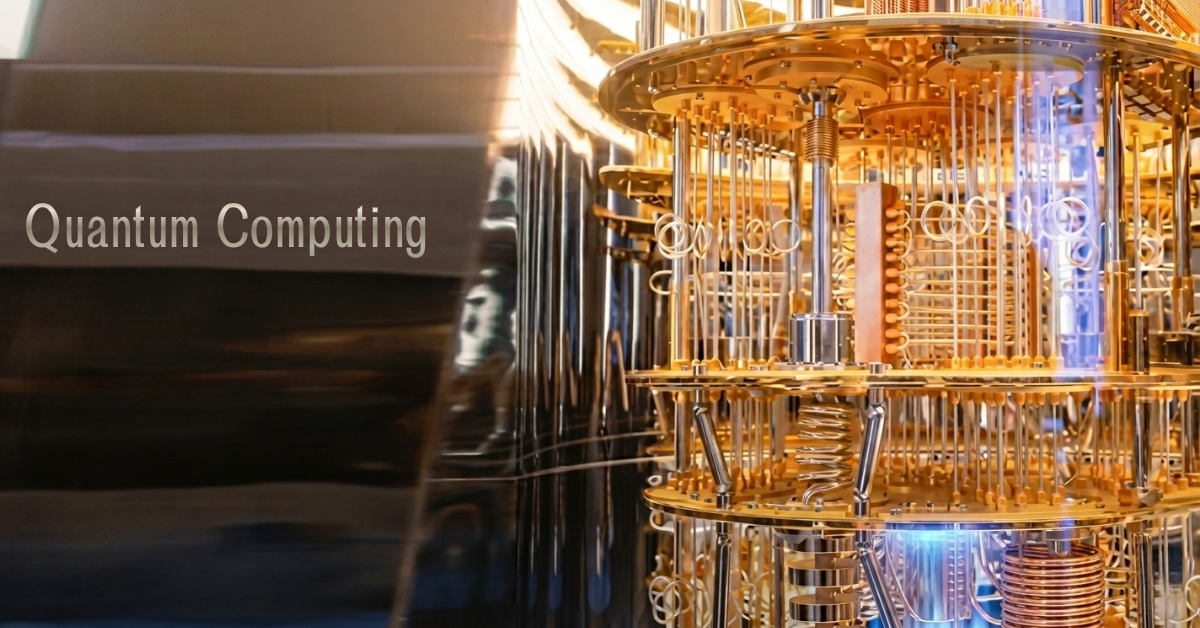
The U.S. government just bet quantum computing‘s future with a historic $2 billion investment in nine firms, including IBM’s record $1 billion grant to build America’s first quantum foundry. Shares in quantum tech stocks surged up to 30% as Washington takes equity stakes, signaling America’s commitment to lead the next technological revolution in drug discovery, encryption, climate modeling, and national defense against China and EU rivals.
What Exactly Is Quantum Computing, and Why Should You Care?
Before we dive into the dollars and the deal, let’s be honest about something: most Americans have heard the term “quantum computing” but aren’t entirely sure what it means. And that’s completely fine, because until recently, it was mostly something discussed in university labs and Silicon Valley boardrooms.
Here’s the short version: quantum computers don’t work the way your laptop or smartphone does. Traditional computers process information in bits — either a 0 or a 1. Quantum computers use something called “qubits,” which can exist in multiple states at the same time. This allows them to solve certain types of enormously complex problems — problems that would take today’s most powerful supercomputers thousands of years to crack — in a matter of minutes or hours.
Think drug discovery, climate modeling, financial risk analysis, encryption, and national defense. These are the kinds of problems that quantum computing is poised to transform. Developers in the field believe this technology will handle challenges that are simply beyond the reach of conventional machines.
The country — and the world — that masters quantum computing first will hold a staggering technological and economic advantage. Washington clearly understands this. And now, it’s acting on it.
IBM Gets the Biggest Slice — And They’re Already Moving
Of the nine companies set to benefit from this landmark investment, IBM is the biggest winner. The Commerce Department has reportedly agreed to give the tech giant $1 billion — making it the single largest recipient in this quantum funding package.
IBM didn’t wait long to announce what it plans to do with the money.
Shortly after The Wall Street Journal broke the story, IBM confirmed it would use the proposed $1 billion grant to build what would be America’s first dedicated quantum foundry — a manufacturing facility built specifically for quantum technology. IBM says this initiative will “accelerate quantum innovation across the United States and enable the production of advanced quantum wafers for a range of companies.”
To sweeten the deal, IBM isn’t just taking government money and running with it. The company is matching the $1 billion grant with $1 billion of its own — bringing the total investment in this effort to $2 billion from IBM alone.
The facility will be operated through a new IBM spinoff company called Anderon, which will be headquartered in Albany, New York, and function as an independent entity. Anderon is described as a state-of-the-art 300-millimeter quantum wafer foundry — the kind of cutting-edge manufacturing operation that doesn’t currently exist anywhere in the country dedicated purely to quantum technology.
IBM’s ambitions here are extraordinary. The company estimates that the broader quantum industry could generate as much as $850 billion in economic value by 2040. Anderon, IBM says, will help put the United States at the center of that boom — strengthening both the country’s economic growth and its national security in the process.
That’s not corporate spin. That’s the kind of long-game thinking that built America’s semiconductor industry — and the kind that, frankly, the country needs more of right now.
he Other Companies That Just Had a Very Good Thursday
IBM isn’t the only company that walked into this deal smiling.
GlobalFoundries, one of the world’s leading chipmakers, is reportedly in line to receive $375 million from this funding package. That’s a serious investment in a company that’s already a cornerstone of America’s semiconductor supply chain.
Three other companies — D-Wave Quantum, Rigetti Computing, and Inflexxion — are each expected to receive around $100 million. And startup Dirac is reportedly set to receive $38 million to support its early-stage quantum work.
The market’s reaction to this news was immediate and dramatic:
D-Wave and Rigetti shares each jumped 23%
Inflexxion surged nearly 30%
Arqit also climbed 30%
IonQ rose 11%
Quantum Computing Inc. gained 17%
And IBM itself saw its shares rise roughly 7%
These are not small moves. A 30% single-day gain is the kind of thing that turns heads on Wall Street and Main Street alike. It signals that investors — the people who put real money behind long-term bets — believe quantum computing is not a distant dream but an imminent reality.
Thursday’s news was remarkable not just for what it is — $2 billion in government support for quantum computing — but for what it represents. It represents a government that has decided to treat quantum technology the way previous generations treated space exploration, the Manhattan Project, or the interstate highway system: as a national priority that requires national commitment.
IBM’s decision to match the investment dollar-for-dollar, and to immediately announce a concrete plan for a world-class quantum foundry, is exactly the kind of response that gives this initiative credibility beyond a press release.
For the companies involved, this is a lifeline and a launch pad. For the American economy, it’s a down payment ones, it’s a message: the United States is not stepping back from the frontier of technology — it’s accelerating toward it.
Quantum computing is no longer just a laboratory experiment. It’s becoming an American industry. And if Thursday is any indication, it’s one that’s just getting started.