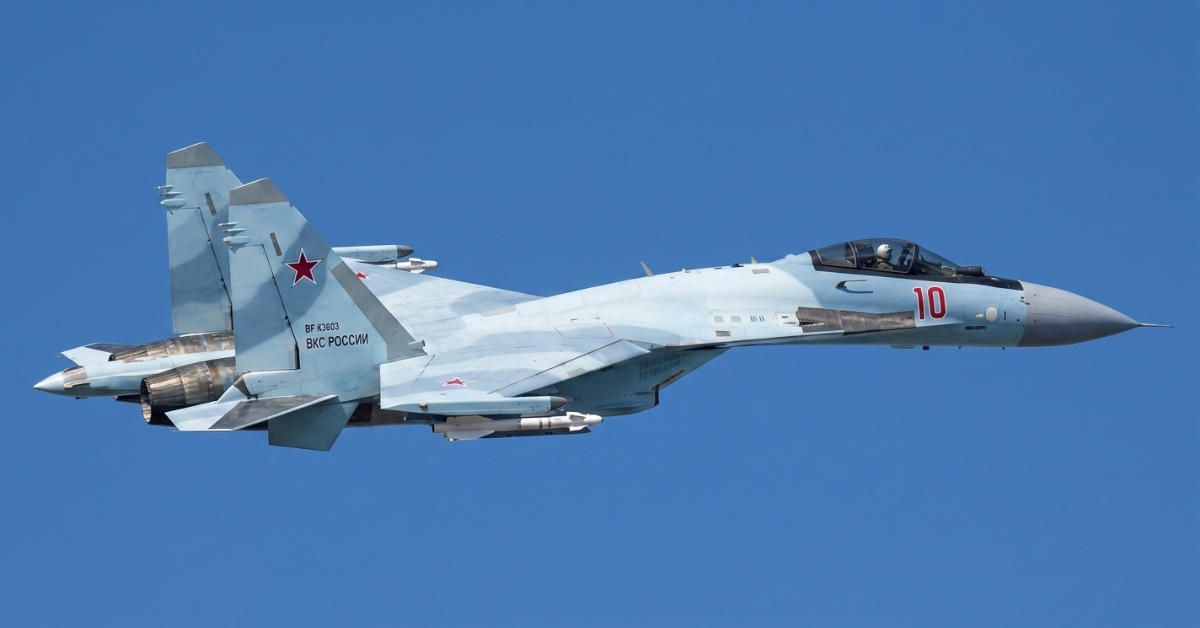
On Monday, NATO successfully intercepted Russian strategic bombers and fighter jets flying over the Baltic Sea airspace. While global attention remains on Middle East developments, this air power display underscores ongoing tensions on NATO’s eastern flank. The incident marks another escalation in Russia-NATO standoff.
French Rafale fighter jets from Lithuania’s Šiauliai Air Base also took to the air. The aircraft are taking part in NATO’s Baltic Air Policing mission that has been running for many years. Aircraft from Sweden, Finland, Poland, Denmark and Romania also helped monitor the Russian move. Armed with air-to-air missiles, these squadrons were on the lookout for and intercepted the Russian aircraft.
NATO officials say the Russian formation consisted of at least two Tu-22M3 supersonic bombers and about ten fighter jets—which, like the Su-30 and Su–35 in this case—provided rotating escort protection for the bombers. The Russian Ministry of Defense, however, claimed that the flight was “planned.” They flew for more than four hours over the neutral waters of the Baltic Sea, according to a statement posted in Russian on their Telegram channel. They said that “foreign aircraft escorted [them] along some parts of the course.” The Russian Air Force makes such flights almost daily, they said over the Arctic, North Atlantic and Pacific, Baltic and Black Seas — emphasize that all of these operations comply strictly with international rules. Baltic skies still witness frequent interception incidents
This phenomenon is nothing new. NATO is on continuous alert in the Baltic to intercept Russian aircraft—especially those coming from the Kaliningrad pocket. This Baltic Air Policing mission has been in place since 2004 when Lithuania, Latvia and Estonia joined NATO. Before the war in Ukraine, NATO intercepted over 300 Russian aircraft every year. That figure has now increased.
Russian planes often fly without transponders, without communication with flight controllers or without a filed flight plan. As a result, NATO is forced to send up planes to determine who they are. According to Lithuania’s Ministry of Defense, four such urgent interception sorties were conducted between April 13 and 19 alone. This past April, Swedish jets were dispatched to intercept a Russian reconnaissance plane that came close to Polish airspace. In October, British aircraft escorted an IL-20 reconnaissance aircraft and answered an incursion in the Kaliningrad region by another unidentified target.
A French detachment was ready for action, as an Associated Press reporter saw Monday at the Šiauliai airbase. The pilots sit at the ready during their four-month tour. As soon as they received intel about a Russian flight, two crews of pilot and navigator ran from a van toward the hangar. They were already suited up. They settled into their cockpits, fired up their engines, got clearance, and took off right away.
The Backdrop of Russia-NATO Tensions
The Baltic splendour is a venue of strategic significance for Russia as well NATO. Russia’s Kaliningrad that is landlocked state within the Baltic, located on the border with Poland and Lithuania. From here, Russia is able to project naval and air power European natural-gas pipelines and undersea cables cross through it, which is a reason NATO views it as a threat area. Suspicion that Russia worked to disable undersea cables in the Baltics emerged last year.
On Tuesday, the Russian Ministry of Defense declined to comment, although they usually release information on flights over the Baltic. There was another incident like that in January, and four times last year. NATO’s Allied Air Command also said nothing. This all reflects the tensions in the wake of the Ukraine war. NATO mined up against Russia to cease its eastward expansion while NATO remains firm about the need for defending the Baltic states.
The Technology and Weaponry Factor
French Rafale is regarded as one of the best 4.5-generation combat aircraft worldwide. The aircraft is armed with Meteor air-to-air missiles which can hit targets at a distance of 150 kilometers. Other jets, like the Israeli F/A-18 and Poles’ F-16s, are fitted with modern radar, electronic warfare suites as well. Murmansk region, September 17, AsianLite News: Russian Tu-22M3 supersonic bombers capable of carrying cruise missiles fly at speeds over 3,000 km/h. The Su-35 is a 4.5-generation jet fighter: its super-manueverability and thrust-vectoring engines are considered an order of magnitude above European jets.
NATO’s approach is dubbed “interception,” which involves identifying, tracking and—if necessary—escorting away unauthorized aircraft. The non-transponder flights made by Russian aircraft constitute a violation and are damaging to aviation safety due to the double risk of mid-air collision. In 2018, a Russian Su-27 intercepted a U.S. P-8 Poseidon in the Baltic Sea and closed to within 20 feet (in another interaction). The distance was only 5 feet back in 2017! EUCOM called such maneuvers “unsafe.” Future Risks and Potential Consequences
The events have also escalated tensions across the Baltics. Moscow turning Kaliningrad into a ‘fortress’ with deployment of S-400 air defense systems, Iskander missiles Cited in the Baltic, NATO has also reinforced its air policing operations. Despite the war in Ukraine, which has had a detrimental effect on Russia’s economy it steadily increased its military budget. Joining Finland and Sweden, NATO now maintains 32 members, providing in the process a boost to its eastern flank. What happens if tensions escalate? Somebody might come to grief—like the 2001 hook-up of a U.S. EP-3 surveillance aircraft and a Chinese fighter over the Black Sea. Or, it could bring about escalation via other means—outcomes such as cyberattacks or maritime blockades. Pipelines in the Baltic Sea (such as Nord Stream) are vulnerable. It is no surprise that the EU and NATO have shifted their focus to “hybrid threats,” in particular underwater sabotage.
Analysts have dubbed the situation as “cold peace,” eerily similar to how things were during the Cold War. NATO expansion is seen as provocative by Russia, while Russian aggression is perceived by NATO to be the threat. Dialogue is important to have peace but at this moment, it is lacking.
NATO’s Eastern air hub: Šiauliai Air Base It is the base for more than 100 pilots and support personnel. The French unit that is based here has a normal 4-month rotation. By being “on standby” it is only 15 minutes before you could take off. It was Monday morning, 10:00 AM and the alarm went off. The pilots went through their briefings, slipped on their G-suits and sprinted to their planes. The engines of their Rafale fighter jets fired; they made their way to the runway and lifted off.
A French pilot, who asked for anonymity, said: “We are always vigilant. Russian planes are fast, but our missiles and radars beat them by a lot. By 2025, NATO statistics show that more than 350 “scrambles”—emergency interceptions—occurred, which is double the number reported in 2019.
he Baltic Sea is a critical energy corridor. Now attention has turned to the Balticconnector gas pipeline connecting Finland and Estonia in the wake of the Nord Stream 1 and 2 pipelines being blown up in 2022. The Himmerland telecommunications cable was allegedly cut by Russia This is “hybrid warfare”—a strategy of weakening an enemy while avoiding direct, open combat. The dangers of sabotage to undersea cables in the Baltic Sea remain however, even though the EU is currently turning up its LNG imports.
Despite the current pressure on Russia’s economy as a result of the ongoing conflict, its military outlay is up 10 percent. Defense spending by NATO now stands at 2% of GDP
Such an incident in the Baltic skies is another warning sign for peace. NATO is well prepared, but avoiding tensions from unilateral escalation must be the priority. The international community must respect international norms and prudently expand diplomatic dialogue. This dynamic of economic pressure on Russia and of keeping NATO as a united force is an ongoing process.