
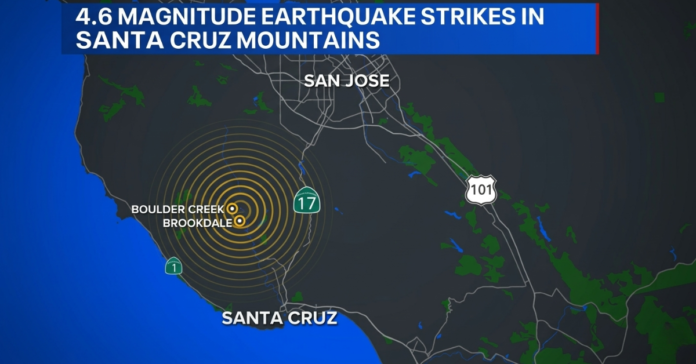
A powerful earthquake registering 4.6 magnitude struck the Santa Cruz Mountains at 1:41 AM Thursday, jolting Bay Area residents from Boulder Creek epicenter to San Francisco, Oakland, and Petaluma with rolling tremors that toppled bookshelves, panicked pets, and shattered dishes—USGS alerts via MyShake app provided timely warnings in this high-hazard zone near 1989 Loma Prieta’s deadly fault lines.
It happened about 6.2 miles underground near Boulder Creek, which is in that foothill area full of faults. The shaking went far, even to Petaluma in the north and San Jose down south. In Boulder Creek, people felt it strong, like bookshelves tipping over. Over in Oakland and SF, it was more like a rolling feeling that lasted five to ten seconds. Up in Petaluma, it was just light tremors, nothing too bad.
The MyShake app sent out alerts right away for quakes over 4.5, and since the epicenter was so close to Boulder Creek, it timed perfectly for folks there. No one got hurt, which is good, and damage was minor, just a bookshelf down in one house and some broken plates here and there. Dogs barking and cats hiding, that kind of panic spread across the region.
Social media posts started flooding in quick. Someone in Oakland said it felt like a truck hit the house, and in SF people were talking about rolling motions that reminded them of the Bay Bridge. It makes you think about 1989, when the Loma Prieta quake collapsed the Cypress Viaduct and killed 63 people, with billions in damage. That one was 6.9, way bigger, and hit a similar spot on Mt. Loma Prieta.
The Santa Cruz Mountains sit right where faults come together, like the San Andreas about 15 miles away, which triggered Loma Prieta back then. There are local thrust faults at the epicenter, and the Hayward Fault further north, around 40 miles. No one knows exactly which one slipped this time, but it is in a hot zone. USGS ranks it 99 out of 100 for hazard.
Aftershocks might come, but the chance is low. In the next 24 hours, maybe five percent for something 4.0 or bigger, and it drops after a week. No sign of the Big One, less than one percent for a 7.0. By 7:15 AM, no tremors over 2.5 had hit, so things quieted down fast. Sequences like this usually fade quick, according to USGS.Bolting water heaters and fastening shelves, like they did there, it seems to pay off. Back in 1989, the Bay Bridge and Cypress failed because no retrofits yet, but now things held up. BART and Caltrain kept running, power stayed on, hospitals normal. Bay Bridge stable this time, no collapses.
This quake kind of reinforces what people should do to prepare. Drop, cover, and hold on, that is what everyone remembers. The MyShake warnings gave about ten seconds notice, which worked. In Boulder Creek, bolted furniture kept that home safe from worse damage. Emergency kits with food and water for 72 hours, family plans printed out, all that stuff.
Bolting water heaters and fastening shelves, like they did there, it seems to pay off. Back in 1989, the Bay Bridge and Cypress failed because no retrofits yet, but now things held up. BART and Caltrain kept running, power stayed on, hospitals normal. Bay Bridge stable this time, no collapses.
Historically, Santa Cruz has seen big ones, like in 1838 a 6.5 or more, and 1865 some ruptures before instruments tracked them well. Then 1989, and now this 4.6 in 2026 as a reminder. Stress builds up steady in the Bay Area, with 72 percent chance of a 7.0 or bigger in 30 years.
Faults around here, San Andreas can do 8.2 max, last big in 1906. Hayward at 7.0, 1868. Calaveras 7.0 in 1911, 25 miles away. This quake does not change the Big One odds, it is just another shake. People on X and TikTok were posting, did you feel it, Boulder Creek shook hard, pets freaking out in SF.
USGS revised the magnitude from 5.1 at first, to 4.9, then 4.6 by 3 AM, using seismographs and all that triangulation. Over 400 reports on their Did You Feel It site by morning. Monitoring aftershocks for a few days, checking fault slips weekly, scanning infrastructure with Caltrans.
The area is prepared better now, retrofitted bridges, early warnings, drills. Hazard maps updated. It proves the Bay Area is the most ready seismic spot in America, I think. But complacency could creep in, since no big damage this time. The jolt wakes people up, but aftershocks fade, and then what.