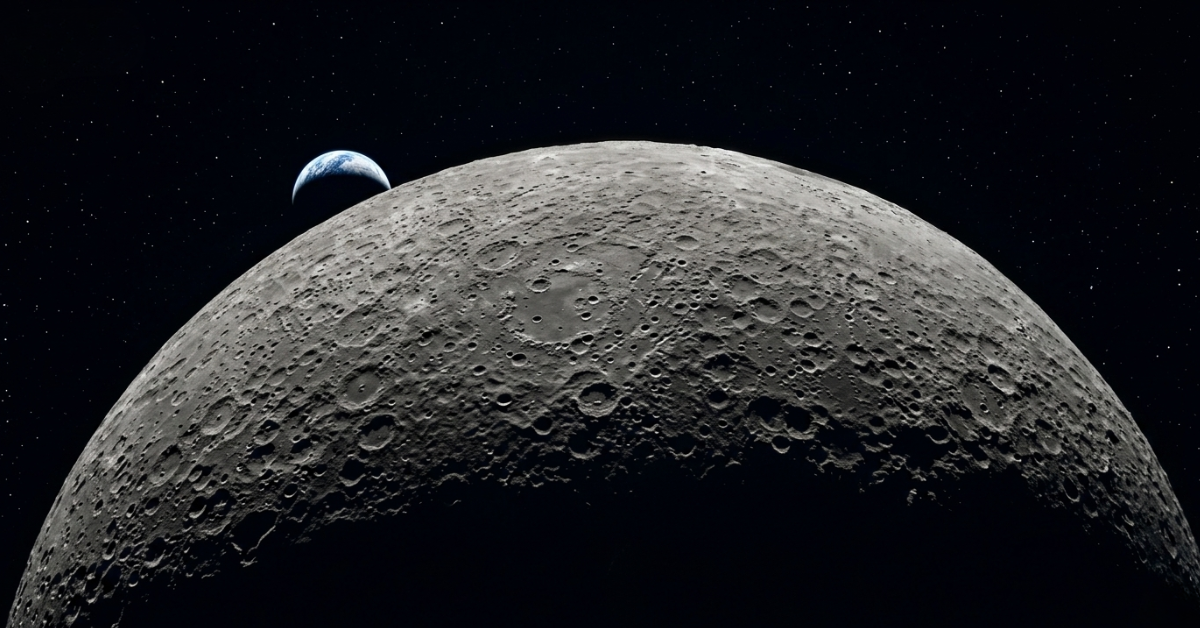
The Artemis II Crew Earthset captured on April 6, 2026, during the Moon flyby shows the cratered lunar surface dominating the foreground through Orion’s window, with a distant, dimly lit Earth glowing faintly behind it—both partially sunlit in perfect Sun-Earth-Moon alignment. NASA astronauts Reid Wiseman, Christina Koch, Victor Glover, and CSA’s Jeremy Hansen snapped this rare view, highlighting light propagation and gravitational dynamics from deep space.
This is not only a beautiful photograph but also one that is invaluable to practically every field of astronomy. It is a rare chance to see how big Earth looks compared to the Moon and how bright it appears in comparison. This image was taken on board NASA’s Orion spacecraft, launched toward the moon by its crew-carrying companion rocket, Launch System (SLS). The members who took the photo were: Reid Wiseman, Christina Koch, Victor Glover (NASA) and Jeremy Hansen (CSA). This mission is the first major step toward a human presence beyond Earth — the first crewed Artemis flight since the Apollo missions that flew in the 1970s — and follows this year’s success of Artemis I.
This photo captures the Moon’s cratered surface in stark detail, while clouds and oceans on Earth glow faintly in the distance. This interaction with sunlight highlights the physics of light propagation and gravitational dynamics in space. The moment NASA posted this image on social media, the hashtag #ArtemisIICrewEarthset started trending.
After the Artemis II Crew Earthset moment, the crew plans to splash down over the Pacific Ocean at 8:07 PM EDT. The Orion capsule recovery team is well prepared, and the crew will be extracted by a coordinated fleet of choppers and recovery ships. This 10-day mission is a rehearsal for Artemis III (the lunar landing in 2027). “This view shows how delicate Earth is,” Wiseman said. Koch is the Commander—the first woman to do so—and Glover is crew’s first Black astronaut.
The Artemis II crew’s “Earthset” offered the world a new view of space. This interaction between the moon and Earth is where the lunar program starts!