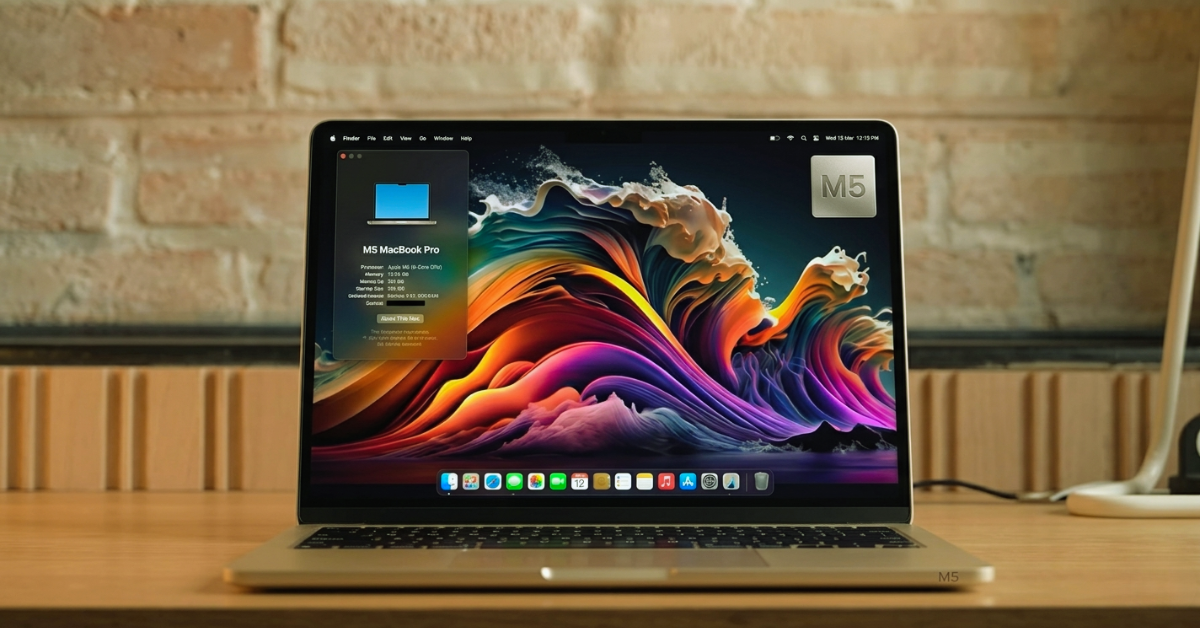
There’s a lot of buzz around Apple stuff lately, and the M5 MacBook Pro seems like it’s going to be a big deal. I mean, after the M4 came out and changed things for people who do creative work or coding, this next one is supposed to take it even further. From what I’ve read from guys like Mark Gurman and Ming-Chi Kuo, it might show up early in 2027, with those 14-inch and 16-inch sizes. The displays sound amazing, Liquid Retina XDR with mini-LED, and battery that lasts way longer than what else is out there. It feels like Apple is really pushing for creators and developers who need power without the hassle.
The design, it builds on what the M4 did, keeping that notch for the screen and Face ID, plus a good 1080p camera. Colors might include this new Space Black, which sounds cool, or just the usual Silver. I think the screens could switch to OLED from Samsung, for better blacks and that high brightness up to 2000 nits, which would help a ton if you’re doing color work or something. Ports are still solid for pros, like three Thunderbolt 5 ones that go super fast at 120Gbps, HDMI 2.1, an SD card slot, and MagSafe charging. The weight is about 3.4 pounds for the smaller one, 4.7 for the big, so it’s not too heavy to carry around. Bezels are thinner now, making the screen take up more space, around 95 percent, and the trackpad is bigger with that haptic feel. Keyboard has Force Touch, and there’s an option for nano-texture glass, I guess to reduce glare.
Audio gets better too, with six speakers for spatial sound and mics that are studio level. Cooling uses vapor chamber, so it stays quiet even when you’re pushing the M5 Max hard, and the palm area doesn’t get hot during long sessions like editing videos. That part stands out to me, because heat can be annoying on laptops.
Now, the chips in the M5 family are made on this 2nm process from TSMC, which should give 20 to 30 percent more performance and efficiency than M4. There’s the base M5 with 10-core CPU, six performance and four efficiency cores, 16-core GPU, starting at 32GB memory. Then M5 Pro has 12-core CPU, 20-core GPU, more memory from 24GB up. The Max version goes to 14-core CPU, 40-core GPU, and up to 64GB or more RAM. It has ray tracing built in, better shading, and AV1 for encoding videos. The Neural Engine is up to 32 TOPS, wait, actually I saw something about it being less than M4’s 38, but maybe that’s not right, anyway it powers Siri updates, Genmoji stuff, and image tools fast. Geekbench leaks show single-core around 4200, multi up to 28,000 for the Max, which beats M4 easily.
For video editors, this thing would handle 8K in Final Cut Pro smoothly, playback without lags, exports quick. In DaVinci Resolve, grading would be faster for pros. 3D work in Blender or Cinema 4D, rendering scenes in real time, ray tracing that used to take forever now minutes. Developers compiling big projects in Xcode, Swift code or Metal, seconds instead of waiting. AI tools like GitHub Copilot run without issues.
Battery is a highlight, 24 hours for video on the 14-inch, 18 for heavy stuff, better than M4’s 22. And it stays cool and quiet. macOS 16, whatever they call it, is tuned for M5, with better game tools, MetalFX for upscaling, local AI. Gaming gets real, like Resident Evil or Cyberpunk at 60fps on high settings at 1440p. Apple Arcade grows, and ports of games like Baldur’s Gate work great in game mode. Neural Engine does Stable Diffusion or Llama models right on the device, no need for cloud.
Pricing starts at 1999 for the 14-inch M5, with 16GB and 512GB. 16-inch Pro at 2499, 24GB and 1TB. Max one over 3499, 64GB and 2TB. You can upgrade storage, 200 for 1TB, 600 for 2TB, RAM steps at 200 each from 24GB. Students get 10 percent off, trade-ins for older M models give 300 to 800 bucks.
Compared to Windows ones, like Dell XPS 16 with Intel and OLED, but battery isn’t as good. Lenovo Yoga has a discrete GPU, but ARM on Windows is behind. ASUS gaming laptop is powerful but heavy and short battery. Apple pulls ahead with the ecosystem and polish, even if Snapdragon X is catching up slow.
Sustainability wise, they use recycled aluminum, reuse magnets, neutral packaging. Repairability is better, maybe 7 out of 10 on iFixit, with battery and SSD you can swap like on iPad.
Timeline has unveiling at WWDC 2026, production in September, sales November. M4s will be on sale cheap, 300 to 500 off, and pre-orders might crash the site.
Colors are Space Black new, Silver, Space Gray. 14-inch good for on the go, 16 for desk work. Connectivity has Thunderbolt 5 for fast eGPUs at 8K, Wi-Fi 7, Bluetooth 6, AV1 for streaming, 240Hz on externals for games. Controllers pair easy.
It seems like the M5 is the peak so far for Apple chips, from M1 surprise to this. For gamers, filmmakers, coders, it’s what they’ve wanted. Kind of makes you think about upgrading, but 2027 is a wait. I might be oversimplifying how it changes everything, though.